


In his work "Jérôme Paturot à la recherche d'une position sociale" (1842) then in " Jérôme Paturot à la recherche de la meilleure des Républiques" (1848) Louis Reybaud evoked Owen's "socio-socialist" endeavours. He praised him not so much for his socialism -f or Reybaud was the enemy of any form of socialism - but for the moral aspect of his reforms, notably the suppression of cabarets for workers, his encouragement of saving and so on. Reybaud preferred to adopt the point of view of, the "boss", the big owner of capital equipment, moralising about the labour of the workers and the working classes in general for he was opposed to any kind of collective manufacturing work. He was opposed to Owen's "socialist" or "communist" optimism, which saw in collective work an opportunity to develop the idea of a common aim for the workers.
Louis Reybaud was married on August 2 1836 in St. Laurent Church, in Paris. He married a widow with seven children. Her husband had been a Marseilles merchant who had inherited the tradition and attitude of the business world where the concept of family had its own meaning as we see in the emphasis on the practical in the marriage contract "the continuation of that harmony and to take every precaution to protect a family home from the harmful influence of events which could disturb their tranquillity and introduce a self-seeking element less disposed to preserve and maintain the union"; On the eve of the February 1848 Revolution and his assassination, His Grace, Denis Affre, Archbishop of Paris, in his pastoral letter on the subject of risks to be run, emphasised that "the doctors of that dreadful science have tried to make the vast majority of men into vile instruments destined to put riches in the hands of a small number of privileged hands". What sort of discussion about these social questions arose between Aristide Cavaillé-Coll and Louis Reybaud (!) (?). He was a witness with Victor Hamille at Adèle and Hippolye Blanc's sister, Zenaïde's first marriage to Alexandre Camus and her second marriage on June 10 1858 to Vincent Cavaillé-Coll, before the entire "clan" assembled in serried ranks at the church of the Trinity.

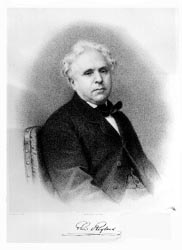
REYBAUD Louis (1799-1879)
Louis Reybaud, like Adolphe Thiers was a merchant's son, born in Marseilles. He was educated at Juilly School and founded a sugar refinery with his brother. In 1828, shortly after his father's death, he left Marseilles for Paris. He explored the capital and joined his friends Barthélémy, Méry, Mignet, Thiers and others throwing himself into politics with them through of journalism and literature. He had travelled a lot in the Levant and, like most of the natives of Provence, he set out to take Paris, and the regime, by storm. Adolphe Thiers was more successful and won the support of liberal opinion. But Reybaud wasn't far behind. He was Cavaillé-Coll's permanent bridge to the ruling powers.